Accumulated Depreciation 101 for Startups
What is Accumulated Depreciation?
Accumulated depreciation refers to the total reduction in an asset’s value over time as it gets used or wears out. This amount is tracked on the company’s balance sheet and helps reflect the current worth of long-term assets. It’s known as a contra asset account because it offsets the original value of the asset. This helps show how much value the asset has lost since the company first acquired it. As the asset continues to be used, the depreciation amount increases year by year. Eventually, when the asset is either sold or no longer in use, both the asset and its accumulated depreciation are removed from the balance sheet. Businesses don’t deduct the entire cost of an asset in one year. Instead, they spread the expense across its useful life. Items like computers, office equipment, vehicles, and machinery often go through this process. You’ll usually see the accumulated depreciation listed right under the original asset value on financial statements.Accumulated Depreciation and Your Startup’s Chart of Accounts (COA)
Accumulated depreciation is an important part of a startup’s chart of accounts (COA) because it keeps track of how much value a fixed asset has lost over time. It’s listed as a contra asset, which means it offsets the original value of the asset on the balance sheet.How It Works:
- Fixed Assets: When your startup buys something like machinery, computers, or furniture, the full purchase amount is recorded in a fixed asset account within your COA.
- Accumulated Depreciation: As time passes and the asset is used, depreciation is recorded regularly. This depreciation total builds up in a separate account and gradually lowers the asset’s book value.
Example of Accumulated Depreciation
Suppose your startup purchases laptops for $10,000, expecting to use them for 5 years. To spread the cost evenly, you would record $2,000 as depreciation each year.- Year 1: $2,000 in accumulated depreciation
- Year 2: $4,000 in accumulated depreciation
- Year 3: $6,000 in accumulated depreciation
- Year 4: $8,000 in accumulated depreciation
- Year 5: $10,000 in accumulated depreciation
How Does Accumulated Depreciation Work?
When you purchase an asset, its value doesn’t vanish all at once. Instead, it decreases gradually. Here’s how the depreciation is applied:- Calculation: Subtract salvage value from purchase price, then divide by useful life.
- Balance Sheet Appearance: Shown as a credit below the asset, reducing its net value.
- Year-over-Year: Depreciation builds cumulatively each period.
- Asset Disposal: Both the asset and its accumulated depreciation are removed.
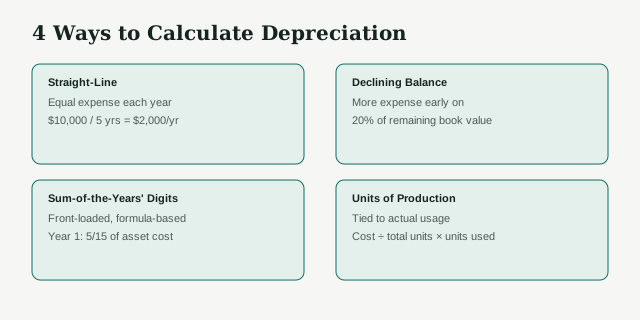
How to Calculate Accumulated Depreciation
There are several recognized methods to compute depreciation:Straight-Line Method
Each year, equal depreciation is applied. Example:- Cost: $10,000
- Useful Life: 5 years
- Depreciation/year = $2,000
Declining Balance Method
This method allows for greater depreciation early in the asset’s life. A common variant is the double-declining balance method. Example:- Cost: $50,000
- Depreciation rate: 20%
- Year 1: $10,000
- Year 2: $8,000 (based on new book value)
Sum-of-the-Years' Digits (SYD)
More depreciation is recognized in the earlier years. Example:- Equipment cost: $15,000
- SYD: 5+4+3+2+1 = 15
- Year 1: 5/15 of $15,000 = $5,000
Units of Production
Depreciation is tied to usage. Example:- Cost: $60,000
- Units: 300,000
- First year: 50,000 units
- Depreciation = 50,000 x $0.20 = $10,000
Accumulated Depreciation vs. Depreciation
- Depreciation: Expense recorded for a single period.
- Accumulated Depreciation: Total depreciation recorded over the asset’s life.
Why Startups Should Track Accumulated Depreciation
For startups, accumulated depreciation offers several benefits:- Improved Financial Accuracy: It shows the true value of assets.
- Tax Benefits: Depreciation deductions lower tax liabilities, following the useful-life tables the IRS sets out in Publication 946.
- Informed Decision-Making: Know when to replace assets.
- Investor Readiness: Gives a clearer financial picture to potential investors.
Need help or guidance? Book a free consultation
LedgersCFO can help ensure your financials are investor-ready. Our team supports early-stage startups with accounting best practices, depreciation planning, and financial modeling. Schedule a free consultation today to get expert advice tailored to your business.FAQs
What is the purpose of accumulated depreciation?
Accumulated depreciation helps businesses spread out the cost of assets over time, matching expenses to the periods in which assets are used.
How does accumulated depreciation affect startup valuations?
It influences the book value of assets and can affect metrics that VCs look at, such as capital efficiency and cash flow.
Can startups skip depreciation if assets are fully paid?
No. Even if an asset is fully paid, accounting standards require depreciation to be recorded to reflect its declining value.
What’s the difference between depreciation and amortization?
Depreciation applies to tangible assets, while amortization is for intangible assets like patents or software.
How does LedgersCFO help with depreciation planning?
LedgersCFO helps startups by setting up accurate depreciation schedules, maintaining records, and ensuring compliance with accounting standards.