Controller or CFO? A Guide for Business Leaders
Should I hire a controller or a CFO? This is the first big financial question many growing business owners face. On paper, both roles appear similar; they involve handling money, preparing reports, and managing budgets. But in reality, their impact on your business is very different. This blog clarifies your confusion and helps you choose whether a controller or CFO is the best fit for your businessWhat Is a Financial Controller?
A controller focuses on your daily financial operations, making sure your books are accurate, bills are paid, and financial reports are prepared on time. They manage the routine work that keeps your financial systems in order and work with existing numbers to ensure everything balances correctly and follows proper accounting standards.Daily responsibilities include:
- Managing accounts payable and receivable
- Preparing financial statements and reports
- Overseeing payroll processing
- Maintaining the general ledger
- Ensuring compliance with accounting standards
- Supervising junior accounting staff
Controller Background and Qualifications
Most controllers bring 5-10 years of hands-on accounting experience to the table. They've worked their way up from basic bookkeeping roles to management positions. Many hold CPA certifications and have bachelor's degrees in accounting or finance. They possess a deep understanding of the technical aspects of accounting.Where Controllers Fit in Your Organization
Controllers usually report directly to the CEO in smaller companies, or to the CFO in larger organizations. They often manage a small team of accounting clerks and bookkeepers. They work closely with other departments to gather financial information and answer questions about expenses, budgets, and financial procedures.What Is a CFO?
 A CFO thinks about the bigger picture. While controllers focus on what happened last month, CFOs are planning what should happen over the next few years.
CFOs use the clean financial data that controllers provide to make strategic decisions about the company's future. They're less concerned with daily transactions and more focused on long-term economic health.
Key responsibilities include:
A CFO thinks about the bigger picture. While controllers focus on what happened last month, CFOs are planning what should happen over the next few years.
CFOs use the clean financial data that controllers provide to make strategic decisions about the company's future. They're less concerned with daily transactions and more focused on long-term economic health.
Key responsibilities include:
- Strategic financial planning and analysis
- Managing investor relations and fundraising
- Overseeing mergers and acquisitions
- Cash flow forecasting and risk management
- Setting financial policies and procedures
- Advising the CEO on major financial decisions
CFO Background and Qualifications
CFOs typically have 10-15 years of progressive financial leadership experience. They've held senior roles and understand how finance impacts overall business strategy. Most have advanced degrees like MBAs or Master's in Finance, plus certifications like CPA or CFA. They combine deep financial knowledge with broad business understanding.Controller vs CFO: The 6 Key Differences
1. Daily Operations vs Strategic Planning
Controllers handle the day-to-day financial tasks that happen every week and month. CFOs work on long-term planning that affects the next several years. Controllers focus on accuracy and compliance. CFOs focus on growth and strategy.2. Accounting Focus vs Business Focus
Controllers are accounting specialists who ensure everything follows proper standards and procedures. CFOs are business leaders who use financial information to guide company decisions. Controllers need deep accounting knowledge. CFOs need a broad business understanding.3. Internal Operations vs External Relations
Controllers primarily work with internal teams and processes. CFOs spend significant time with external stakeholders like investors, banks, and board members. Controllers keep internal systems running. CFOs represent the company's financial health to the outside world.4. Historical Reporting vs Future Planning
Controllers excel at accurately reporting what has already happened. CFOs use that historical data to predict and plan for what's coming next. Controllers provide the foundation of reliable data. CFOs build future strategies on that foundation.5. Department Leadership vs Company Leadership
Controllers typically lead the accounting department. CFOs influence financial decisions across the entire organization. Controllers have focused authority. CFOs have a broad influence.6. Operational Efficiency vs Strategic Direction
Controllers optimize how financial processes work. CFOs determine where the company should be heading financially. Controllers support where you are now. CFOs help you get where you want to go.What Controllers Do Every Day
Controllers manage the financial operations that keep your business running smoothly. Their work happens on predictable schedules with clear deadlines. Core controller functions:- Preparing monthly financial statements
- Managing cash flow and banking relationships
- Overseeing accounts receivable collections
- Processing accounts payable and expense reports
- Coordinating annual audits with external accountants
- Implementing internal financial controls
- Training and supervising accounting staff
What CFOs Do Every Day
CFOs split their time between internal strategy work and external relationship management. Their schedule varies more based on company needs and market opportunities. Core CFO functions:- Developing long-term financial strategies
- Creating detailed budgets and forecasts
- Managing relationships with investors and lenders
- Analyzing potential mergers or acquisitions
- Assessing new market opportunities
- Presenting financial results to stakeholders
- Advising on major business decisions
When to Hire a Financial Controller
Your business probably needs a controller when financial tasks start overwhelming your current resources or capabilities. Signs you need a controller:- You're behind on basic bookkeeping and reporting
- Financial errors are becoming a frequent problem
- You need better internal controls and processes
- Compliance requirements are getting complex
- You want to free up leadership time for strategic work
When to Hire a CFO
Your business needs a CFO when you're ready for more sophisticated financial planning and external relationships. Signs you need a CFO:- You're preparing for significant fundraising rounds
- Strategic financial decisions are becoming more complex
- You're considering major acquisitions or expansions
- Investor relations require professional management
- Long-term planning needs dedicated expertise
What Size Companies Need Each Role?
- Startups under $1M revenue: Usually handle finances internally or with basic bookkeeping help
- Companies $1M-$10 revenue: Typically start with a controller to establish solid financial operations
- Companies $10M-$50 revenue: Often add a CFO while keeping the controller for daily operations
- Companies over $50M revenue: Usually need both roles working together as revenue and complexity increase
Budget-Friendly Alternatives for Growing Businesses
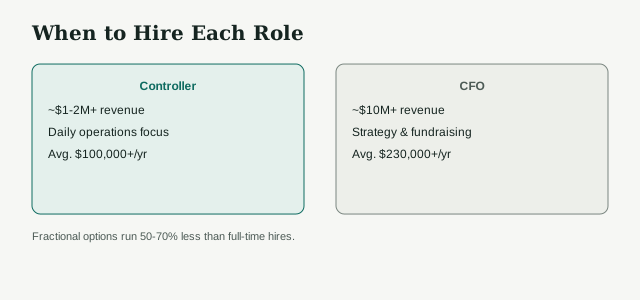
Full-time financial executives are expensive. Controllers average $100,000+ annually, while CFOs average $230,000+ per year, and good recordkeeping following the IRS's own standards makes either hire more effective from day one. Fractional options offer flexibility:- Part-time controllers for regular but not full-time needs
- Fractional CFOs who work with multiple companies
- Outsourced accounting services for controller-level functions
- Project-based CFO consulting for specific needs
Building a Strong Financial Team
The best financial leadership often comes from controllers and CFOs working together as complementary partners. Controllers provide the solid operational foundation that CFOs need for strategic planning. CFOs provide the strategic direction that helps controllers prioritize their work effectively. Successful financial teams typically develop this way:- Start with strong bookkeeping and basic financial management
- Add controller-level expertise to establish solid systems.
- Bring in a CFO-level strategy as growth opportunities increase.
- Build both roles working together as the company matures
Common Pitfalls to Avoid
- Hiring a CFO when you need a controller: Strategic planning doesn't help if your basic financial operations are broken.
- Expecting one person to excel at both roles: The skill sets are different. Controllers think operationally, CFOs think strategically.
- Waiting too long to get help: Financial problems get more expensive to fix the longer you wait.
- Choosing based on prestige instead of needs: Hire for the problems you actually need solved, not the title that sounds more impressive.
Making Your Decision
Start by assessing your biggest financial challenges right now, using the SBA's guide to managing business finances as a baseline. If your main issues are:- Messy books or inaccurate reports then? You need a controller.
- Behind on basic financial tasks? You need a controller.
- Planning for growth or fundraising? You need a CFO.
- Making strategic financial decisions? You need a CFO.
- Can you afford full-time help, or should you start with part-time?
- Do you need someone immediately, or can you plan?
- Will your needs change significantly in the next 1-2 years?
- Where do you want your company to be in 3-5 years?
- What financial capabilities will you need to get there?
- How can you build your financial team to support those goals?
Need support building a realistic budget for your startup?
[Schedule Your Free Consultation]
At LedgersCFO, we work with founders to create clear and practical budgets that match their stage of growth. Our experienced CFOs help you set spending priorities, manage cash flow, and make sure your funds are used effectively. With the right plan in place, you’ll stay on top of your finances, avoid costly mistakes, and move forward with confidence as you prepare for future growth or fundraising.FAQs
Is a controller higher than a CFO?
No. A CFO holds the senior position and sets strategy, while a controller manages accounting operations and often reports to the CFO.
Can a controller become a CFO?
Yes. Many controllers step into CFO roles after gaining leadership experience and developing broader business skills.
Do small businesses need both a controller and a CFO?
Not usually. Most small businesses start with a controller for daily financial tasks, then add a CFO as the company grows and requires more strategic planning.
At what stage should a startup hire a controller or CFO?
A controller is often needed once revenue passes $1–2 million, while a CFO becomes important closer to $10 million or when fundraising and long-term growth planning come into play.
How can LedgersCFO help my startup decide between a controller and a CFO?
LedgersCFO works with founders to assess financial needs and growth plans. Our team guides you on whether a controller, CFO, or a fractional option is the right fit for your business stage.