Form 8822-B Explained: Filing Rules & Deadlines
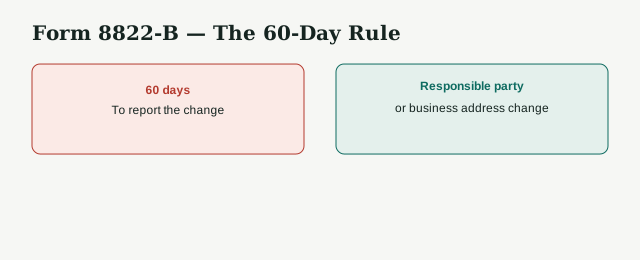
Form 8822-B is the one-page IRS form businesses use to report three specific changes: a new mailing address, a new physical business location, or a new "responsible party" on file with the EIN. Address changes are strongly recommended but carry no hard deadline. A responsible party change is different — you have 60 days from the date the change takes effect to file, and the clock doesn't wait for you to notice it's running. Skipping this form doesn't trigger a fine by itself, but it does mean IRS notices, including ones with real deadlines attached, can legally go to an address or person that no longer has anything to do with your company. For founders who set up their entity through a formation service or registered agent, this is more common than it sounds — and more expensive to unwind than the ten minutes it takes to file correctly.
What is Form 8822-B, exactly?
Form 8822-B, officially "Change of Address or Responsible Party — Business," is the IRS's mechanism for keeping its records current on any entity that has an EIN, whether or not that entity is actively trading, invoicing, or running payroll. That includes corporations, LLCs of any size, partnerships, trusts, estates, and nonprofits. A single-member LLC that's gone completely dormant but still has an EIN on file is just as obligated to file this form as an active company with a full accounting team.
Three types of change trigger a filing, and they can all be reported on the same form if they happen together: a change in the mailing address where the IRS sends correspondence, a change in the entity's actual physical location if that differs from the mailing address, and a change in the responsible party — the individual the IRS holds accountable for the entity's tax matters.
Form 8822-B vs. Form 8822 — don't mix these up
These two forms get confused constantly, and the confusion isn't harmless — each one updates a completely separate set of IRS records. Form 8822 (no "B") is for an individual updating their personal home address, tied to their Social Security Number or ITIN. Form 8822-B is for the business entity itself, tied to the EIN.
If you're a sole proprietor and you move, filing one of these doesn't cover the other. You'd file Form 8822 for your personal address and Form 8822-B separately for the business address associated with your EIN. Sending the wrong form updates nothing you actually needed updated.
Who is required to file Form 8822-B?
Any entity with an EIN that goes through one of the three triggering changes is required to file — regardless of whether it's currently generating revenue. In practice that covers C-corps and S-corps relocating their principal office or replacing a CEO, partnerships and multi-member LLCs changing address or appointing a new general partner or managing member, single-member LLCs and sole proprietors that file employment or excise returns under their own EIN, and trusts, estates, or nonprofits with EINs of their own.
The responsible party requirement in particular doesn't get waived just because the entity is quiet. A holding company or shell entity that changes ownership still has 60 days on the clock.
What actually counts as a "responsible party" change, per the IRS's EIN guidance?
The responsible party is whoever the IRS considers to actually control the entity's funds and decisions — not just whoever happens to sign the return. For a corporation that's typically the CEO or president; for an LLC, the managing member; for a partnership, a general partner.
The trigger for a required filing is narrower than people assume. Bringing on a new investor doesn't automatically require a change. Adding a co-signer on a bank account doesn't either. What does trigger it: a founder stepping down and handing over control, a managing member being replaced, an acquisition that shifts who runs the entity, or a formation agent's employee being listed on the original EIN application and never updated afterward.
That last one is worth sitting with for a second, because we see it constantly with Delaware C-corps set up by Indian founders through incorporation services. The EIN application (Form SS-4) needs a responsible party at the moment of filing, and if the founder wasn't available or the process was handled entirely by the formation agent, an employee of that agent sometimes ends up listed by default. Nobody notices because nothing goes wrong — until an IRS notice goes to that agent's old office instead of the founder, and sits there.
Why the 60-day deadline matters more than it looks like it should
There's no explicit penalty printed on Form 8822-B for missing the deadline, and that leads a lot of founders to deprioritize it. The actual risk isn't a fine — it's what happens when the IRS acts on outdated information. If the agency mails a notice of deficiency to whatever address is on file, that notice is legally valid whether or not anyone at your company ever sees it. That notice starts a 90-day window to petition Tax Court. Miss it because the letter went to an old address or a person who left two years ago, and you lose the right to contest the assessment at all.
We worked with an early-stage Delaware C-corp where the original EIN listed the founder's US-based formation agent contact as the responsible party. Two years later, after a full leadership change and a new US mailing address, nobody had filed Form 8822-B. When an IRS compliance letter went out, it went to the agent's office, not the founder — and by the time it was forwarded, the response window had nearly closed. Nothing catastrophic happened in the end, but it was closer than it needed to be, and entirely avoidable with a single one-page form.
Address changes work differently — there's no statutory deadline, but the same exposure applies. Every week your address is wrong on IRS records is a week you might miss something that has its own separate deadline.
How to actually file it
Form 8822-B is paper-only; there's no e-filing option. You'll need your entity's legal name exactly as it appears in IRS records, your EIN, the old address exactly as the IRS has it on file, the new address or new responsible party's name and SSN/ITIN, and a signature from an owner, officer, or authorized representative. Where you mail it depends on your old business address, not your new one — the IRS routes based on where your account currently sits. Send it certified mail with a return receipt, and keep a copy. If a responsible party change is involved, that mailing receipt is your proof you met the 60-day window if it's ever questioned.
Where do you mail Form 8822-B?
Routing is based on your old business address, not your new one, because that's the address currently tied to your account in IRS systems. If your prior address was in Connecticut, Delaware, DC, Georgia, Illinois, Indiana, Kentucky, Maine, Maryland, Massachusetts, Michigan, New Hampshire, New Jersey, New York, North Carolina, Ohio, Pennsylvania, Rhode Island, South Carolina, Tennessee, Vermont, Virginia, West Virginia, or Wisconsin, the form goes to the IRS service center in Kansas City, MO 64999. Every other state, plus any entity with a foreign address, mails to Ogden, UT 84201-0023.
Sending it to the wrong center doesn't lose the filing, but it typically adds several weeks while the IRS reroutes it internally — which matters if you're racing a 60-day responsible party deadline.
What happens after you submit it?
Address updates generally take four to six weeks to process. For employment tax accounts, the IRS may send confirmation notices (CP148A and CP148B) to both the old and new address once the change is recorded — keep these as proof the update went through. If six to eight weeks pass with no confirmation, call the IRS Business and Specialty Tax Line at 1-800-829-4933, or mail a follow-up copy marked "Second Request" at the top.
One limitation worth flagging: filing Form 8822-B only updates IRS records. It does nothing for your registered agent address with the Secretary of State, your state tax agency, your state unemployment account, or any other government system. If you've relocated the business, each of those typically needs its own separate update.
Bottom line: Address changes on Form 8822-B are good hygiene; responsible party changes are a hard 60-day deadline with real consequences if IRS notices end up in the wrong hands. If your EIN still lists someone who no longer controls the company — including a formation agent's contact from when you first incorporated — that's worth fixing now, not after a notice goes missing.
FAQs
Is there a penalty for not filing Form 8822-B?
No direct fine, but the indirect risk is significant. The IRS can legally mail notices to your last address on file, valid whether or not you receive them. A missed notice of deficiency can end your right to challenge a tax assessment in Tax Court entirely.
Can I file Form 8822-B electronically?
No. It's a paper-only form with no IRS e-filing option. You print, sign, and mail it to the service center based on your old business address — Kansas City or Ogden, depending on state. Certified mail is strongly recommended for proof of filing.
What if my EIN still lists someone who's no longer involved with the company?
File Form 8822-B naming the correct current responsible party as soon as possible. If more than 60 days have passed since the actual change took effect, filing late is still far better than leaving outdated information on record — but the sooner it's corrected, the lower the exposure.
How long does it take the IRS to process Form 8822-B?
Address changes generally take four to six weeks. If you haven't received confirmation after six to eight weeks, call the IRS Business and Specialty Tax Line at 1-800-829-4933 or mail a follow-up copy marked "Second Request."
Does Form 8822-B update my state records too?
No. It only updates federal IRS records. Your registered agent address, state tax agency, and state unemployment account each require separate updates through their own processes.
Who signs Form 8822-B?
An owner, officer, general partner or LLC managing member, plan administrator, fiduciary, or authorized representative. If someone signs on behalf of the entity as a representative rather than a principal, Form 2848 (Power of Attorney) typically needs to be attached.
By Ayush Garg, LedgersCFO
Need help with this? Talk to our team.