How is income taxed in the USA
The U.S. operates a progressive income tax system. This means that the more you earn, the higher the percentage of your income you pay in taxes. The Internal Revenue Service (IRS) is responsible for collecting federal income tax, while states and some cities may levy their own additional taxes. In the U.S., individuals and entities must report all their taxable income annually. This includes salaries, wages, dividends, interest, rental income, capital gains, and even profits from overseas sources for residents. Each year, taxpayers file their returns—typically on or before April 15—to declare income and pay any balance owed. Non-residents, including Indian founders who operate businesses that generate U.S. income, are also subject to certain tax obligations. The key difference is that U.S. citizens and residents are taxed on worldwide income, while non-residents are only taxed on income that comes from U.S. sources.Who Pays Income Tax in the USA?
There are three main taxpayer categories in the U.S.: 1. Individuals (U.S. citizens and residents): Taxed on income from all global sources. 2. Non-resident aliens (foreign nationals): Taxed only on U.S.-sourced income. 3. Corporations and entities: Taxed based on the type of business structure and income source. If you’re an Indian company earning through a U.S. LLC or partnership, you may be considered a “foreign-owned disregarded entity.” In such cases, the entity must file forms like Form 5472 and Form 1120 to report transactions with the foreign parent company. Failing to do so can lead to heavy penalties, as explained in Penalties for Incorrect US Tax Filing by Indian Businesses.Understanding Federal, State, and Local Taxes
1. Federal Income Tax
This is the main tax collected by the IRS. The rates are progressive, ranging from 10% to 37%, depending on income levels. Deductions, credits, and exemptions reduce the taxable income.2. State Income Tax
Most U.S. states impose their own income taxes, with rates varying widely. States like Texas and Florida have no income tax, while California and New York have higher brackets.3. Local or City Taxes
Certain cities, such as New York City, also collect local income taxes. These are much smaller in comparison but still affect overall taxation. Foreign businesses operating in multiple U.S. states must understand the “nexus” rule—if your company has a sufficient presence or economic activity in a state, you may owe taxes there as well.What Counts as Taxable Income
Taxable income is not limited to salaries or wages. It includes a wide range of sources such as:- Business income
- Dividends and capital gains
- Rental income from property
- Royalties and intellectual property earnings
- Interest from savings or investments
- Bonuses and commissions
Tax Rates for Individuals and Businesses
Individual tax rates:
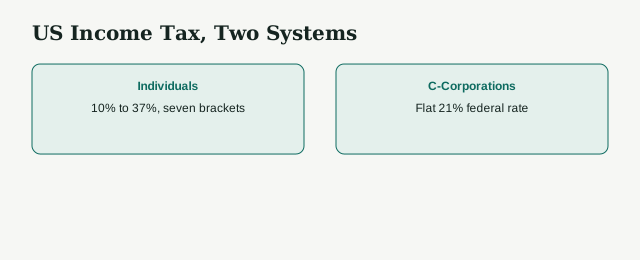
For 2026, the federal tax brackets range from 10% for income up to $12,400 (single filers) to 37% for income exceeding $640,600, adjusted annually for inflation. Taxpayers can reduce liability through deductions such as mortgage interest, education credits, and charitable contributions.Corporate tax rates:
After the Tax Cuts and Jobs Act (TCJA) of 2017, the corporate tax rate in the U.S. was reduced to a flat 21%. However, pass-through entities like LLCs, S-corporations, or sole proprietorships are taxed differently—profits “pass through” to owners’ individual tax returns. Indian founders who create U.S. LLCs should ensure they understand these distinctions and file accordingly. For guidance, many businesses rely on a cross-border tax consultants who specialize in compliance and filing.Filing Taxes for Non-Resident Businesses
Foreign businesses that earn income from U.S. customers must comply with specific IRS filing requirements. For instance: Form 1120-F – Used by foreign corporations to report income connected to U.S. business operations. Form 5472 – Mandatory for foreign-owned entities to disclose related-party transactions. Form W-8BEN or W-8BEN-E – Certifies foreign status to avoid unnecessary tax withholding. Not filing these correctly can lead to fines and reputation risks. Professional firms like Ledgerscfo assist Indian businesses in preparing and submitting these documents to ensure compliance with IRS regulations.How Tax Treaties Help Avoid Double Taxation
India and the United States have a Double Taxation Avoidance Agreement (DTAA), designed to prevent businesses from paying tax on the same income in both countries. Under this treaty, Indian residents can claim credit in India for taxes paid in the U.S., provided the income was reported correctly in both jurisdictions. For example, if a U.S. company withholds 15% on payments to an Indian contractor, that amount can be claimed as a tax credit in India. However, to claim treaty benefits, accurate documentation and correct filings are essential. Errors or inconsistencies between Indian and U.S. returns can cause treaty benefits to be denied.Tax Deductions and Credits
The U.S. tax system offers numerous deductions and credits to reduce taxable income. Businesses can deduct expenses like salaries, rent, marketing, and technology investments. Individuals can claim deductions for healthcare, education, and mortgage interest. Foreign companies can also deduct legitimate business expenses incurred while generating income in the U.S. Maintaining accurate records is crucial, which is why many rely on Professional bookkeeping services for businesses to keep documentation organized and IRS-ready.Common Mistakes to Avoid
Indian businesses expanding to the U.S. often make avoidable mistakes due to unfamiliarity with local regulations. Some frequent errors include: 1. Treating a U.S. LLC as a separate taxable entity instead of a pass-through. 2. Ignoring U.S. state taxes while filing only federal returns. 3. Not maintaining transfer pricing documentation for cross-border transactions. 4. Submitting incorrect W-8BEN forms. 5. Failing to align Indian and U.S. accounting records. These issues can easily be prevented with proper guidance and an understanding of cross-border taxation, as detailed in How Indian Founders in Bangalore Can Scale US Clients Without Tax or Compliance IssuesImportance of Compliance and Record-Keeping
The IRS pays special attention to foreign-owned companies to ensure accurate reporting. Maintaining well-documented records—contracts, invoices, and bank transfers—is essential. When your financial data is transparent, you reduce the risk of audits or disputes. Proper bookkeeping ensures that both Indian and U.S. filings remain consistent. This also helps when applying for business loans, attracting investors, or undergoing audits.Consequences of Incorrect Tax Filing
Filing errors can be expensive. The IRS imposes penalties for underreporting income, missing deadlines, or submitting incorrect forms. For example, failing to file Form 5472 correctly can result in a $25,000 fine per year. Repeated errors or negligence can lead to audits, suspended business accounts, or loss of treaty benefits. Businesses must ensure every transaction, expense, and report matches across jurisdictions to avoid these issues. If you’ve already made filing mistakes, refer to Penalties for Incorrect US Tax Filing by Indian Businesses for detailed steps on how to correct them efficiently.Working With Professionals for Compliance
Given the complexities of the U.S. tax system, it’s best to work with experts who understand both Indian and American regulations. Experienced consultants can:- File your returns correctly and on time.
- Ensure compliance with international tax treaties.
- Handle multi-state filings and reporting.
- Optimize deductions to minimize liabilities.
The Future of Taxation for Global Businesses
With globalization and digital commerce growing rapidly, tax authorities worldwide are becoming more coordinated. The IRS and Indian Income Tax Department now share data under global transparency initiatives. This means businesses cannot afford to overlook compliance anymore. Automation tools, AI-based accounting, and expert financial advisors are transforming how companies manage taxes. Staying compliant today ensures smoother scaling tomorrow, both in the U.S. and globally.Key Takeaways
1. The U.S. uses a progressive tax system where income levels determine rates. 2. Residents are taxed on global income; non-residents on U.S.-sourced income. 3. Indian companies must file U.S. tax forms accurately to avoid penalties. 4. Tax treaties between India and the U.S. prevent double taxation. 5. Proper record-keeping and professional advice ensure smooth compliance. By understanding the fundamentals of U.S. income tax and keeping your filings accurate, you protect your business from legal risks and position it for long-term growth.FAQs
Who pays income tax in the USA?
Both U.S. citizens and residents pay taxes on worldwide income, while non-residents pay taxes only on income earned in the U.S.
What is the corporate tax rate in the U.S.?
The corporate tax rate is currently 21% at the federal level, though states may impose additional taxes.
Are Indian companies required to file U.S. taxes?
Yes, if your business earns income from U.S. clients or operates a U.S. entity, you must file taxes.
What happens if I file my U.S. taxes late?
Late filings attract penalties and interest charges. In some cases, you may also lose eligibility for certain deductions or credits.
How can Indian founders avoid double taxation?
By using the India-U.S. DTAA, which allows you to claim credits in India for taxes paid in the U.S.
Do I need to pay both federal and state taxes?
Yes, most businesses owe federal tax and may also owe state tax depending on where they operate.
What documents are required for filing?
You’ll need financial statements, invoices, transaction records, and appropriate IRS forms such as Form 1120 or Form 5472.
Can I handle U.S. tax filings myself?
You can, but it’s risky without proper knowledge. It’s better to consult professionals or a cross-border tax advisor for accuracy.
What deductions can businesses claim?
Common deductions include salaries, rent, marketing, software costs, and professional services.