Form 7004: Business Tax Extension
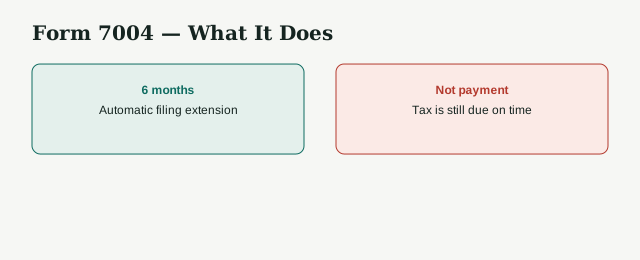
What is Form 7004? Form 7004 is a request to the IRS for more time to file certain business tax returns. It’s used by corporations, partnerships, trusts, and estates. If approved, you can get up to six more months to file. But it doesn’t give extra time to pay taxes. However, it only extends the filing deadline. You still need to pay your estimated taxes by the original due date. In this guide, we’ll cover who can use Form 7004, how to file it, important deadlines, mistakes to avoid, and what happens if you miss the deadline.Who Should File Form 7004?
You can use Form 7004 if your business is:- A corporation – including C corporations (Form 1120), S corporations (Form 1120S), and personal service corporations.
- A partnership – general or limited, filing Form 1065.
- An LLC – filing as a corporation or partnership.
- A trust or estate – filing Form 1041.
Purpose and Advantages of Filing Form 7004
Review the IRS's Form 7004 instructions to confirm which of the eligible return types applies to your entity.
The main reason for using Form 7004 is to get more time so your tax return is complete and correct. Advantages include:- Extra time (up to six months) to organize records and avoid mistakes.
- Reduced the chance of missing deductions or credits.
- Avoidance of late-filing penalties.
- Flexibility to handle tax preparation alongside other business priorities.
Filing Deadlines for Form 7004
The deadline is the same as your original tax return due date:- March 15 for Partnerships and S corporations.
- April 15 for C corporations and most trusts.
How to File Form 7004 Step by Step:
Step 1: Decide if You Need an Extension
File if you are waiting for key documents, need to finalize financial statements, or want more time for accurate reporting.Step 2: Gather Required Information
- Employer Identification Number (EIN)
- Business name and address
- Tax form number you are extending
- Tax year-end date
- Estimated tax liability and payments made
Step 3: Complete the Form
Fill in business details exactly as they appear on your tax records, specify the form number, and provide your tax year information.Step 4: Estimate and Pay Taxes Owed
Estimate your tax liability using prior returns and current-year data. Pay at least 90% of the total by the original due date to avoid penalties.Step 5: File the Form
- E-file – Fast, with confirmation in 24–48 hours.
- Mail – Use certified mail and keep the receipt.
Key Points to Keep in Mind
Individuals requesting more time file Form 4868 instead, not Form 7004.
- File before the original tax due date.
- E-filing is faster than mailing.
- Keep a record of your submission for your reference.
- Filing the form late will not grant an extension.
What Happens If You Don’t File On Time?
Missing the Form 7004 deadline can quickly become expensive for your business.- Late Filing Penalty – For income tax returns like Form 1120 (C corporations) and Form 1041 (trusts and estates), the IRS charges 5% of the unpaid tax for every month (or part of a month) your return is late, up to a maximum of 25%. Partnerships (Form 1065) and S corporations (Form 1120S) face a different penalty: a flat $220 per partner or shareholder, per month the return is late, for up to 12 months, regardless of whether any tax is owed. This means even being a few days late can start adding costs.
- Late Payment Penalty – Even if you file an extension, failing to pay at least 90% of your estimated tax by the original due date triggers a 0.5% penalty per month, up to a maximum of 25% of the unpaid amount.
- Interest Charges – Interest starts building from the original due date until the tax is fully paid. This is charged on top of penalties, so the longer you delay, the more you owe.
- Higher Risk of Errors – Rushing to file without enough preparation often leads to calculation mistakes, missed deductions, and IRS notices asking for clarification or additional tax.
Common Mistakes to Avoid
- Filing after the original return due date.
- Assuming it extends the payment deadline (it doesn’t).
- Entering the wrong tax form number.
- Underestimating taxes owed by too much.
- Filing one form for multiple entities instead of separate ones.
Need help or guidance?
LedgersCFO can prepare and file Form 7004 accurately and on time. We calculate your estimated tax, complete the form correctly, file it using the best method for your situation, and keep records for future reference. With our support, you can meet IRS requirements without the risk of late-filing penalties.FAQs
How long does Form 7004 extend the deadline?
It gives you an extra 5 or 6 months to file your return, depending on the type of tax form you’re using.
Does it also extend my payment deadline?
No. You still need to pay your estimated taxes by the original due date to avoid penalties and interest.
Can I file Form 7004 online?
Yes. You can file it through the IRS e-file system, tax software, or an IRS-authorized e-file provider.
What happens if I miss the filing date for Form 7004?
You could face late-filing penalties and interest, and you will not get extra time to submit your return.
How does LedgersCFO make the process easier?
LedgersCFO manages the calculations, prepares Form 7004, submits it on time, and keeps your records organized so the extension process is smooth and accurate.