Managing Burn Rate and Cash Runway
Your startup is spending money every month. The important question is how fast it is going and how long before the cash runs out. Many founders just guess these numbers. Some say, “We have about six months left,” without actually doing the math. Others watch every single expense but still miss the bigger picture. Here’s how you can clearly understand where you stand and what to do about it.Understanding How Fast You Burn Through Cash
Your burn rate is essentially the amount of money that disappears from your account each month. There are two ways to look at this:- Gross burn means the total money your company spends in a month. It covers expenses like rent, salaries, software tools, and other office costs. This figure shows the amount you need every month to keep your business running.
- Net burn is what you spend minus what you earn. If you spend $50,000 but bring in $20,000, your net burn is $30,000. This gives you a better picture of how fast you're actually losing money.
Calculating Your Runway
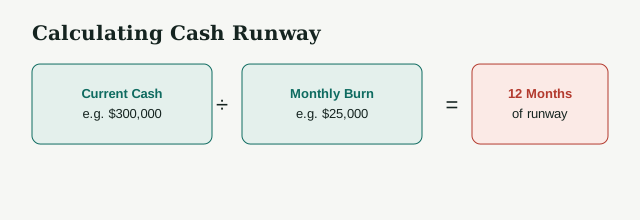 Cash runway is how long your current money will last at your current spending rate. The math is simple:
Current cash ÷ Monthly burn rate = Months of runway
Example: If you have $300,000 in the bank and you're burning $25,000 per month, you've got 12 months of runway.
Cash runway is how long your current money will last at your current spending rate. The math is simple:
Current cash ÷ Monthly burn rate = Months of runway
Example: If you have $300,000 in the bank and you're burning $25,000 per month, you've got 12 months of runway.
What Affects Your Burn Rate
Every decision you make changes how fast you spend money. Here are the big ones:Hiring New People
Each new employee doesn't just cost their salary. It costs equipment, office space, and the time spent onboarding them. A $60,000 salary might actually cost you $80,000 when you consider these expenses also. Early-stage startups should hire carefully. Only bring on people when you absolutely need them, not when it would be nice to have them.How You Pay Vendors
The timing of payments makes a huge difference. If you can negotiate 60-day payment terms instead of 30-day, you keep cash in your account longer. Some vendors offer discounts for annual payments up front. Sometimes it's worth paying early if the discount is significant.Customer Payment Terms
Getting customers to pay upfront or annually instead of monthly improves your cash flow dramatically. A customer paying $12,000 upfront is much better than $1,000 monthly payments, even if the total is the same. Offer incentives for annual payments. A small discount is worth it to get cash in the door now instead of hoping customers stick around for 12 months.Office and Overhead Costs
Office rent, software subscriptions, and other fixed costs add up fast. Remote work can save thousands per month in office expenses, but make sure it actually works for your team. Review recurring subscriptions quarterly. You'd be surprised how many unused tools accumulate over time.Planning for Different Scenarios
Smart founders prepare multiple scenarios to understand how different choices impact their cash runway. Best-case scenario: Sales targets are achieved, expenses remain controlled, and the team operates without major changes. Worst-case scenario: Sales decline, an important customer leaves, or unexpected hiring becomes necessary. Most likely scenario: A balanced outcome, reflecting the typical ups and downs of running a business. Building these models allows founders to make informed decisions. For example, hiring a senior engineer may be feasible in the best case but too risky in the worst case.Warning Signs Your Burn Is Too High
Watch for these red flags:- Your runway is under 12 months, and you're not close to profitability
- Burn rate is increasing faster than revenue
- You're spending more on customer acquisition than customers are worth
- Fixed costs are eating up most of your budget
Quick Ways to Extend Your Runway
Immediate fixes:
- Pause non-essential hiring
- Renegotiate payment terms with vendors
- Cut software subscriptions you don't actively use
- Offer customers discounts for paying annually upfront
Longer-term strategies:
- Focus spending on activities that directly generate revenue
- Negotiate annual customer contracts instead of monthly
- Consider remote work to reduce office costs
- Regularly review and cut underperforming marketing channels
When to Start Fundraising
Don't wait until you have three months of cash left to start fundraising. The process usually takes 6-12 months from start to finish. Most investors want to see at least 12-18 months of runway remaining. It shows you're planning ahead and not desperate for money.Building Better Cash Management Habits
- Track everything weekly, not monthly. Monthly reviews miss problems until it's too late. Spend 30 minutes each week reviewing your burn rate and cash position.
- Automate what you can. Use tools that automatically pull in bank data and categorize expenses. Manual tracking takes too long and misses things.
- Plan for the unexpected. Keep a buffer for emergencies. If your model says you have 12 months of runway, assume you really have 10.
- Make decisions based on data, not gut feelings. When someone suggests hiring a new person or buying expensive software, run the numbers first.
Getting Professional Help
Managing cash flow gets complicated as you grow. The SBA's guide to managing business finances and its startup cost calculator are good starting points, but you might benefit from professional help if:- Your burn rate changes significantly month to month
- You're planning to raise funding in the next 12 months
- You have multiple revenue streams or complex contracts
- You're spending more time on financial models than building your product
FAQs
What is a startup burn rate?
Burn rate is the amount of money a startup spends each month to cover its expenses. It helps founders understand how quickly their available cash is being used.
How do I calculate my cash runway?
Cash runway is calculated by dividing your available cash by your monthly burn rate. For example, if you have $300,000 in the bank and spend $50,000 per month, your runway is 6 months.
Why should startups plan for different scenarios?
Because business conditions change. Sales might grow, expenses might increase, or unexpected events could happen. Scenario planning helps you stay prepared and make better decisions.
How often should I update my burn rate and runway?
You should track your burn rate weekly to stay aware of changes, but update your official runway forecasts monthly. This balance gives you both visibility and reliable long-term planning.
How does LedgersCFO help startups manage their finances?
At LedgersCFO, we go beyond basic accounting. We help startups track their burn rate, forecast their runway, and build scenario models to guide decision-making. Our outsourced CFO services provide clarity, so founders can focus on growth while staying financially prepared.