Section 174A: Your R&D Deduction Guide
Section 174A, added by the One Big Beautiful Bill Act (OBBBA), brings back the option to immediately deduct domestic research and experimental (R&E) costs in the year you incur them, reversing the mandatory five-year amortization that had been in place since 2022. But "you can deduct it all now" isn't automatically the right move for every business. The choice between immediate expensing and voluntarily capitalizing those costs over time can quietly change how much of your business interest expense is deductible, whether you generate a bigger net operating loss than you actually want this year, and, for very large companies, whether you trigger the corporate alternative minimum tax. For most founders and small businesses, the headline deduction is still the better call. But if you're carrying debt, sitting on losses from prior years, or operating at the billion-dollar scale where minimum-tax rules apply, it's worth running the numbers before you default to expensing everything.
What changed with Section 174A?
From 2022 through 2024, the tax code required all R&E spending (software development, product engineering, prototyping, and similar costs) to be capitalized and amortized over five years for domestic work, and fifteen years for R&E performed outside the US, even though most businesses were used to deducting these costs immediately. Because of the mid-year convention, that "five-year" recovery actually spans six tax years, but five-year is the usual shorthand. That rule caught a lot of founders off guard, since it meant paying tax on income that hadn't actually shown up as cash yet.
Section 174A restores the immediate deduction for domestic R&E, effective for tax years beginning after December 31, 2024. It's permanent, with no sunset. Foreign R&E is unaffected: it still has to be capitalized and amortized over fifteen years under the original Section 174 rules. Software development costs are treated as R&E under Section 174A regardless of where the work is done, so domestic software development qualifies for immediate expensing while foreign software development stays on the 15-year schedule.
One companion change matters for the rest of this discussion: the same OBBBA also restored the EBITDA-based calculation of adjusted taxable income (ATI) for the business interest limitation under Section 163(j), also effective for tax years beginning after December 31, 2024.
Your three options for handling R&E costs now
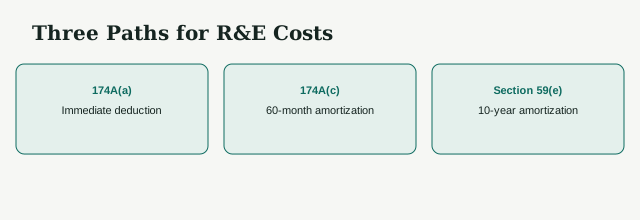
The reinstated law actually gives you three paths, not one:
- Immediate deduction (Section 174A(a)). Deduct domestic R&E costs in full as you incur them. This is the default most businesses will want. Adopting it is a change in accounting method, made under the IRS's automatic-consent procedures in Rev. Proc. 2025-28 (often via a statement in lieu of a full Form 3115).
- Shorter voluntary capitalization (Section 174A(c)). Elect to capitalize and amortize costs over a minimum of 60 months, beginning with the month you first realize benefits, instead of deducting them immediately. Rev. Proc. 2025-28 (released August 28, 2025) sets out the mechanics for making this election, so it's no longer unguided, though some interpretive questions (such as how granularly the election applies) are still being worked through.
- Longer voluntary capitalization (Section 59(e)). A separate, older election that lets you capitalize a specific dollar amount of R&E costs and amortize them over a fixed 10 years. It's less flexible on timing than 174A(c), but its rules are well established, which makes it the more predictable choice if you specifically want to spread deductions out.
Why would anyone choose to capitalize instead of just deducting everything?
This is the part that surprises founders: taking the full deduction isn't free of side effects. Three situations where spreading the deduction out can actually work in your favor:
You're carrying business debt. The limit on how much interest expense you can deduct in a year is 30% of your ATI. Here's the piece people miss under the restored EBITDA-based rules. An immediate R&E deduction is an ordinary current deduction that is not added back when computing ATI, so expensing everything pushes your ATI, and your interest ceiling, down. Amortized R&E works differently: the amortization deduction is added back to ATI, so capitalizing leaves your ATI, and your interest capacity, largely intact. If you expense everything and your ATI drops, you may end up with disallowed interest carried forward indefinitely, which is useful in theory but only as good as your ability to actually use it in a future profitable year.
We've seen this play out with a venture-backed software company carrying a modest venture debt facility: full R&E expensing pushed their ATI low enough in one year that a chunk of their interest expense got stuck in a carryforward instead of being deductible that year. A partial Section 59(e) election the following year kept enough ATI in place to avoid repeating it.
You're generating a loss you don't need this year. Net operating losses only offset 80% of taxable income in a future year, and there's no guarantee you'll have enough future income to use them before they lose value to you. If immediate R&E expensing is about to turn a break-even year into a large loss, capitalizing some of those costs instead can keep more of the deduction available for a year when you can actually use it.
You're a very large company near corporate AMT territory. This one applies only to big corporations. The corporate alternative minimum tax (CAMT) is generally 15% of adjusted financial-statement (book) income, and it only applies to corporations averaging roughly $1 billion or more of that book income over three years. The mechanism is a book-tax difference: a large R&E deduction lowers your regular tax but not your book income, so if it drops your regular tax below the 15% book-income floor, CAMT can kick in. If your company is anywhere near that scale, model it before expensing a large R&E balance in one year.
A note for pass-through owners. Even well below the CAMT thresholds, individual AMT can matter. For AMT purposes, individuals must capitalize R&E and amortize it over 10 years, so partners and S-corp shareholders receiving K-1s with large domestic R&E can see a meaningful gap between their regular-tax deduction and their AMT treatment. It's worth checking at the owner level, not just the entity level.
What about the R&D credit?
If you claim the research credit, remember that the OBBBA restored the interaction between the credit and the deduction. You generally have to reduce your R&E deduction by the amount of the credit, or elect the reduced credit under Section 280C(c) to keep the full deduction. If you're both expensing R&E and claiming the credit, factor this in rather than assuming you get the full deduction and the full gross credit.
Which option should you actually pick?
For the majority of founders (no meaningful debt load, not sitting on old losses, nowhere near CAMT scale), Section 174A(a)'s immediate deduction is still the simplest and usually the best answer. The exceptions above are the cases worth modeling before you file: run your numbers both ways (full deduction versus a partial Section 59(e) capitalization) and see whether the interest expense or NOL effects change your actual tax bill enough to matter. If they do, Section 59(e) is generally the more dependable tool right now, since its rules are well established and it lets you pick the exact dollar amount to capitalize.
Bottom line: Most businesses should still take the immediate R&E deduction under Section 174A(a). But if you're carrying debt, sitting on losses, or operating at CAMT scale, it's worth modeling a partial Section 59(e) capitalization before you file, since the "obvious" choice isn't always the cheapest one.
What about the 2022 to 2024 costs I already capitalized?
There are two separate paths here, and they're often confused.
The first is a transition rule open to every taxpayer, regardless of size. For domestic R&E you capitalized in 2022 through 2024, you can elect to deduct the remaining unamortized balance either in full on your first return for a tax year beginning after December 31, 2024, or ratably over two years (that first year and the next). This is claimed on the 2025 return and is still available.
The second was a special retroactive election for small business taxpayers, letting them amend 2022 through 2024 returns to apply Section 174A in those original years. That election carried a hard deadline: the earlier of July 6, 2026, or the refund statute of limitations for each year. That window has now closed, so amending prior years specifically under the OBBBA small-business election is no longer available. If you think you qualified and never made it, talk to your advisor about whether any normal amended-return options still apply to your open years.
FAQs
Do I have to capitalize R&E costs anymore?
No. For domestic R&E in tax years beginning after December 31, 2024, immediate deduction is back as the default under Section 174A(a). Capitalization is now voluntary, unless the R&E was performed outside the US, which still requires 15-year amortization.
Who counts as a "small business taxpayer" for the retroactive rules?
Generally a taxpayer meeting the Section 448(c) gross-receipts test: average annual gross receipts of about $31 million or less (the inflation-adjusted 2025 figure) over the prior three years. You had to qualify for your 2025 tax year to use the retroactive election.
Can I still go back and fix R&E costs I already capitalized in 2022 to 2024?
It depends which path you mean. The all-taxpayer transition rule (deduct the remaining unamortized balance in 2025, or over 2025 and 2026) is still available and is claimed on your 2025 return. The special small-business election to amend 2022 through 2024 returns closed on July 6, 2026, so that specific route is no longer open.
What's the real difference between Section 174A(c) and Section 59(e) capitalization?
Section 174A(c) offers a shorter minimum period (60 months), and Rev. Proc. 2025-28 now provides the procedure for making it, though some interpretive questions remain. Section 59(e) requires a fixed 10-year period but lets you choose the exact dollar amount to capitalize, and its rules are well established.
Does taking the deduction affect my R&D credit?
Yes. You generally reduce the deduction by the credit amount, or elect the reduced credit under Section 280C(c) to keep the full deduction. Coordinate the two rather than assuming you get both in full.
Does this affect foreign R&E costs?
No. R&E performed outside the United States still must be capitalized and amortized over 15 years under the original Section 174 rules. Section 174A only restores immediate expensing for domestic R&E.
By Ayush Garg, LedgersCFO
Need help with this? Talk to our team.