Smart SaaS Accounting Basics
TL;DR:
SaaS accounting tracks recurring revenue, deferred and accrued income, and customer lifetime value. Accrual accounting is preferred to match revenue with service delivery. Bookings show total contracts, billings track invoices, and revenue reflects services delivered. Mistakes like mixing deferred and accrued revenue or delaying expense recording can distort finances. LedgersCFO helps SaaS startups set up accurate, compliant, and investor-ready accounting systems.
When you run a subscription-based business, your revenue doesn’t come from one-time sales; it builds up month after month. That’s where SaaS accounting becomes essential. Unlike traditional bookkeeping, SaaS accounting focuses on tracking recurring income, deferred revenue, and customer lifetime value accurately.
If you’re managing a growing SaaS company, understanding how to record income and expenses the right way can help you avoid compliance issues and give investors a clear picture of your financial health. Let’s break it down in simple terms.
Why SaaS Accounting Works Differently
A SaaS company doesn’t “deliver” its product in one go. Instead, it provides a service continuously for as long as the customer’s subscription lasts.
For instance, imagine a customer pays $1,200 upfront for a yearly plan. You can’t record the full amount as income immediately. It must be recognized monthly, as you deliver the service. That’s the essence of SaaS accounting: recognizing revenue gradually to reflect the actual performance of your business.
The Two Accounting Methods You’ll Hear About
In the SaaS world, you’ll come across two main approaches: one is cash basis and the other is accrual basis.1. Cash-Basis Accounting
Revenue and expenses are recorded only when money actually moves in or out of your bank. It’s simple but doesn’t show the full financial picture, especially for subscription-based businesses.2. Accrual Accounting
Revenue is recorded when it’s earned, even if the payment hasn’t arrived yet. This method gives a true reflection of your Monthly Recurring Revenue (MRR) and Annual Recurring Revenue (ARR), which is why most SaaS companies follow it.
Most SaaS companies stick with accrual accounting once they scale beyond a few customers because it helps them forecast better and stay compliant with financial standards.
Understanding Revenue Recognition in Saas accounting
Revenue recognition is one of the trickiest but most important parts of SaaS accounting. Under ASC 606, revenue must be recognized as the service is delivered, not when the payment is received. For tax purposes, IRS Publication 538 and Section 451(c) of the tax code govern how advance payments like annual prepayments are treated, which can differ from book treatment under ASC 606.
Here’s a simple way to think about it:
If your company offers a $100 monthly plan, you recognize $100 as revenue each month, even if the customer paid $1,200 for the entire year upfront.
This principle helps keep your books consistent and makes sure investors and auditors can trust your financial reports.
What is Deferred and Accrued Revenue
If you’re just starting out, these two terms might feel confusing at first but they’re key to getting SaaS accounting right. A major shift in your recognition policy can also require filing Form 3115 to request an accounting method change with the IRS.
Deferred revenue is money you’ve received but haven’t yet earned. For example, if a client pays $6,000 in January for a six-month contract, that money sits on your balance sheet as a liability and is recognized month by month as you deliver the service.
Accrued revenue, on the other hand, is the opposite. It’s revenue you’ve earned but haven’t yet invoiced or collected. Maybe your client used your service for a month, but the invoice is still pending that’s accrued revenue.
Getting this distinction right ensures your financial statements reflect reality, not just cash flow.
Bookings, Billings, and Revenue in SaaS Accounting
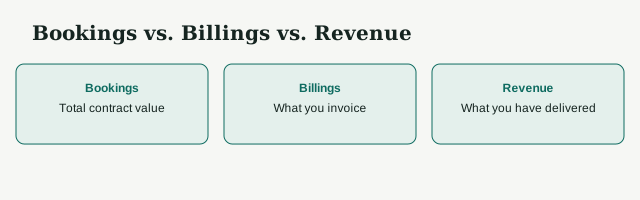
In SaaS accounting, understanding bookings, billings, and revenue is key and each represents something different in your business. Here’s a simple way to look at it:
-
Bookings – This is the total contract value you’ve signed, representing future revenue.
Example: You sign a 12-month subscription deal with a client for $12,000. That $12,000 is your booking, showing your revenue potential for the year. -
Billings – This is the actual amount you invoice your customers.
Example: You send the client an invoice for $1,000 per month. The $1,000 is billings for that month. Even though the total booking is $12,000, you only record what’s invoiced. -
Revenue – This is the money you’ve earned after delivering your service.
Example: After providing one month of access to your software, you recognize $1,000 as revenue. The rest of the contract will be recognized as the service is delivered.
Tracking all three helps you understand where your money really stands and avoid overestimating your growth.
Common Mistakes SaaS Founders Make
Many SaaS founders start with enthusiasm but stumble when it comes to financial accuracy. Some of the most common errors include:
-
Mixing up deferred and accrued revenue
-
Forgetting to record refunds or plan upgrades
-
Ignoring foreign exchange fluctuations for international users
-
Delaying expense recording until tax season
While these might seem small, they can distort your profit reports and complicate investor discussions later. Setting up proper SaaS accounting systems early helps you avoid such issues altogether.
How LedgersCFO Can Help
At LedgersCFO, we understand the challenges SaaS founders face. From managing deferred revenue to ensuring compliance with ASC 606, we simplify your accounting so you can focus on scaling your product
Our experts specialize in SaaS accounting for startups and growing subscription companies across the US. Whether you need help setting up revenue recognition or streamlining your recurring billing, we’re here to make it simple and stress-free.
Book your free consultation today and let us help you build a clear, compliant, and investor-ready financial foundation.
FAQs
What is SaaS accounting and why is it important?
SaaS accounting manages the financials of subscription-based software businesses. It ensures accurate revenue recognition and compliance with accounting standards.
Why can’t SaaS companies use traditional accounting?
Because their income is earned gradually, not at once. Traditional methods can misrepresent their revenue and growth.
What is the best accounting method for SaaS companies?
Accrual accounting, as it aligns revenue with service delivery and supports accurate forecasting.
How does ASC 606 affect SaaS businesses?
It requires SaaS companies to recognize revenue as services are performed, not when cash is received.
Why should SaaS founders work with LedgersCFO?
LedgersCFO’s accounting specialists handle everything from compliance to automation, making your SaaS financial management effortless and accurate.