Tax Implications of Owning a CFC
What Is a Controlled Foreign Corporation (CFC)?
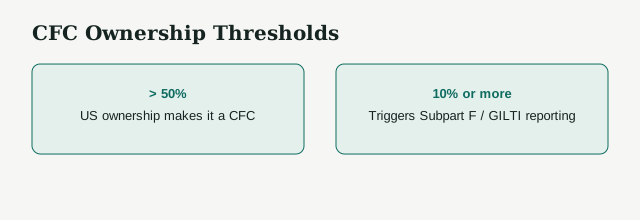
A Controlled Foreign Corporation (CFC) is a foreign company where more than 50% of the value or voting rights are held by U.S. shareholders. Even though the company operates overseas, U.S. tax rules may still apply to its income.
This means U.S. shareholders might have to pay taxes on income they haven’t actually received yet. Knowing these rules helps avoid unexpected tax bills and keeps you compliant with the IRS.
Key U.S. Tax Rules for CFCs
Owning a CFC comes with several special rules. Here are the main ones:
1. Subpart F Income
Certain types of income like passive earnings (interest, dividends, royalties), related-party sales, or insurance income, must be reported by U.S. shareholders even if the money stays in the company.
2. GILTI (Global Intangible Low-Taxed Income)
This covers high returns from a CFC above a standard return on its tangible assets. Some foreign tax credits apply, but they might not cover all U.S. taxes.
3. Ownership and Attribution Rules
U.S. tax law looks at direct, indirect, and even family-owned shares. This helps determine if a foreign company qualifies as a CFC.
4. Reporting Requirements
Every U.S. shareholder must file Form 5471 annually. Missing it can lead to penalties.
5. Transition Tax
Previously untaxed foreign earnings may be subject to a one-time U.S. tax, whether or not the money is distributed.
6. Participation Exemption
Some U.S. corporations can deduct certain dividends received from a CFC, lowering or eliminating tax on that income.
7. BEAT (Base Erosion and Anti-Abuse Tax)
This rule sets a minimum tax on U.S. companies making payments like interest or royalties to related foreign parties. It helps prevent profit-shifting.
Subpart F Income and Its Implications
Immediate Taxation
Subpart F income is taxed even if profits are not distributed. This prevents indefinite deferral of U.S. taxes.
Types of Subpart F Income
-
Passive income (dividends, interest, royalties, rents, annuities)
-
Related-party transactions
-
Insurance earnings and certain sensitive income
Impact on Ownership
Even indirect shareholders (like family members) may be responsible for Subpart F income. Ownership structure matters, so plan carefully.
Compliance
File Form 5471 annually and maintain proper records to avoid penalties.
Foreign Tax Credits & How to Save on Taxes
The Foreign Tax Credit (FTC) lets you reduce U.S. taxes by the amount already paid to a foreign government. But you can only claim credit up to the U.S. tax owed on that income.
Practical Strategies for Tax Efficiency
-
Combine High-Tax and Low-Tax Income
Offset U.S. taxes by grouping foreign income from high-tax countries with low-tax countries. -
Carryback and Carryforward Options
Extra credits can be applied to last year’s taxes or saved for future use (up to 10 years). -
Choose Tax-Efficient Structures
Use partnerships or disregarded entities overseas to make FTC claims easier. -
Plan for GILTI Taxes
Match foreign taxes carefully with GILTI income. Only 80% of foreign taxes can be credited. -
Use Check-the-Box Elections Correctly
Decide how foreign entities are taxed in the U.S. to optimize credits. -
Apply Basket Rules Properly
Organize income types (general, passive, GILTI) to avoid lost credits. -
Keep Clear Documentation
Track all foreign taxes, invoices, and official statements in case the IRS asks for proof. -
Avoid Abusive Arrangements
Only use legitimate, real transactions. Fake setups can lead to penalties.
Need help or guidance? [Schedule a free consultation today.]
At LedgersCFO, we understand that owning a foreign corporation as a U.S. shareholder comes with complex tax rules. You might be taxed on income even if it hasn’t been paid out to you, and tracking what counts as taxable can be challenging.
This is where our team supports you. We help you understand how the tax rules apply to your ownership and make sure you stay compliant with U.S. laws. From identifying taxable income to planning to reduce your tax burden, we guide you through each step.
While you focus on growing your business internationally, we make sure your tax matters are handled correctly and with peace of mind.
FAQs
What makes a company a controlled foreign corporation?
A foreign corporation is a CFC when U.S. shareholders together own more than 50% of its voting power or value, counting only those U.S. shareholders who each hold at least 10%. For Indian founders the usual trigger is a U.S. person holding a stake in an Indian private limited company.
Do I owe U.S. tax on profits I have not distributed?
Potentially yes. Subpart F income and GILTI can both create a current U.S. tax charge on a 10% U.S. shareholder even when no dividend has been paid. This is the point founders most often miss.
Which form reports a CFC?
Form 5471, filed with the U.S. shareholder's return. The category of filer determines which schedules are required.
Does this apply if I moved to the U.S. after incorporating in India?
Yes. The obligation follows your U.S. tax status, not the order of events. A founder who becomes a U.S. person while holding shares in an Indian company can acquire a Form 5471 obligation without any transaction taking place.