Startup Tax Planning: R&D & QSBS
Startups operate on tight margins and make fast decisions, so every financial move, including tax decisions, matters. Smart tax planning from the outset helps reduce your tax burden, access valuable credits, and build a stronger financial foundation. This blog covers tax strategies that help startups lower costs, improve cash flow, and plan for growth.Why Tax Planning Early Matters
From your first day, tax decisions impact how much you save, your cash flow, and your ability to deal with investors or regulators. Good tax planning can:- Lower how much tax your business pays overall.
- Free up more cash to run your company.
- Help you avoid costly penalties from mistakes.
- Make sure you use all tax credits and deductions available to you.
Best Tax Structure for Startups in 2025
The legal entity you pick shapes how you're taxed, how much liability protection you have, and how easy it is to raise funds.| Entity Type | Key Tax Points | Best For |
| Sole Proprietor | Simple but no liability protection. Income taxed personally. | Solo founders, earliest stages |
| Partnership | Pass-through tax. Partners pay taxes on profits. | Co-founders, service-based startups |
| LLC | Flexible tax treatment. Can elect corporate or pass-through. | Founders wanting liability shield |
| S-Corp | Pass-through tax but limited ownership rules. | Smaller teams, tight ownership |
| C-Corp | Separate tax entity. Enables QSBS and VC backing. | Venture-funded, growth-focused |
How to Use the R&D Tax Credit as a Pre-Revenue Startup
Even if your startup isn’t profitable, you may qualify for the R&D tax credit, claimed on IRS Form 6765. It can help reduce up to $500,000 in payroll taxes per year for five years. This applies to companies developing new products, improving systems, or creating software.Don’t Miss Out on QSBS Benefits
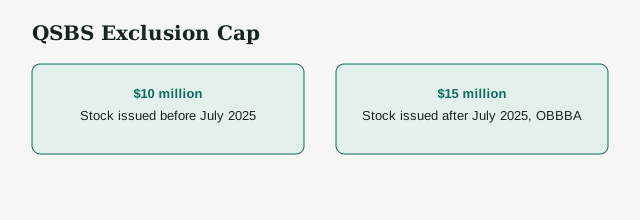 QSBS is defined and governed under Section 1202 of the tax code, with further guidance in IRS Publication 550. Suppose your company is a C-corporation and your shares qualify as Qualified Small Business Stock (QSBS). Under the One Big Beautiful Bill Act (OBBBA), stock acquired after the law's July 2025 enactment qualifies for a higher exclusion cap of $15 million (up from $10 million) and a tiered holding schedule: 50% of gains are excluded after 3 years, 75% after 4 years, and 100% after 5 years. The company's aggregate gross assets test also rose from $50 million to $75 million. Stock acquired before the OBBBA's enactment still follows the original rules: a $10 million cap (or 10x your basis) and a full 5-year hold to exclude 100% of gains.
Meet the other QSBS conditions and plan the timing of your stock issuance carefully.
QSBS is defined and governed under Section 1202 of the tax code, with further guidance in IRS Publication 550. Suppose your company is a C-corporation and your shares qualify as Qualified Small Business Stock (QSBS). Under the One Big Beautiful Bill Act (OBBBA), stock acquired after the law's July 2025 enactment qualifies for a higher exclusion cap of $15 million (up from $10 million) and a tiered holding schedule: 50% of gains are excluded after 3 years, 75% after 4 years, and 100% after 5 years. The company's aggregate gross assets test also rose from $50 million to $75 million. Stock acquired before the OBBBA's enactment still follows the original rules: a $10 million cap (or 10x your basis) and a full 5-year hold to exclude 100% of gains.
Meet the other QSBS conditions and plan the timing of your stock issuance carefully.
Dedications: Save Money from Day One
- Startup costs: Deduct up to $5,000 for expenses like market research or training.
- Organizational costs: Deduct up to $5,000 for legal fees and other setup costs.
- If you spend more on either, the rest is deducted gradually over 15 years.
Additional Tax Strategies for Founders
- Everyday Expenses: Deduct costs like legal, marketing, rent, or software.
- Section 179: Write off new equipment (like laptops and servers) up to the allowed annual limits.
- Net Operating Losses: If your business loses money, you can "carry forward" those losses to reduce your taxes in future years.
- Equity Compensation: Use stock options to reward and retain employees while conserving cash.
Startup Tax Mistakes to Avoid
- Missing quarterly tax payments: Plan for these if you expect to owe over $1,000 in taxes.
- Poor record-keeping: Bad books mean missed deductions and can trigger audits.
- Waiting too long: Don’t wait for tax season to start planning early.
Tips for VC-Backed Startups
- Review your business structure before any fundraising or exit.
- Coordinate with your CFO to align tax strategies with your cash flow and growth objectives.
- Regularly review your tax plan, since laws change
Get Tax Clarity with LedgersCFO
Book a free consultation with LedgersCFO
LedgersCFO helps early-stage and venture-backed startups build smarter tax strategies. Our team can:- Maximize your credits like R&D and QSBS
- Review your entity structure for fundraising readiness
- Support exit and equity planning
FAQs
What startup costs can I deduct in the first year?
You can deduct up to $5,000 in startup costs and $5,000 in organizational expenses, with the rest spread over 15 years.
Can I still claim the R&D tax credit if I’m pre-revenue?
Yes. If your company qualifies, you can use the credit to reduce payroll taxes even without income.
Do I need a C-Corp to qualify for QSBS?
Yes. Only C-Corporation stock qualifies for QSBS treatment. The company must also meet asset and business requirements.
What happens if I don’t pay estimated taxes?
You may owe penalties and interest. If your business expects to owe over $1,000 in taxes, you likely need to pay quarterly.
How does LedgersCFO help with tax planning?
We work with startups to create tax strategies that reduce liability, avoid mistakes, and prepare for growth, funding, or exit.