Form 1120 Guide: Filing Taxes for Small Businesses
By Ayush Garg, Founder, LedgersCFO
If your startup is a Delaware C-corp, Form 1120 is your federal income tax return, and the IRS expects it whether you booked $10 million in revenue or nothing at all. Most first-time founders either miss it, file it late, or forget the one attachment that carries a $25,000 penalty. Here's what Form 1120 actually is, when it's due, and where cross-border founders trip every single year.
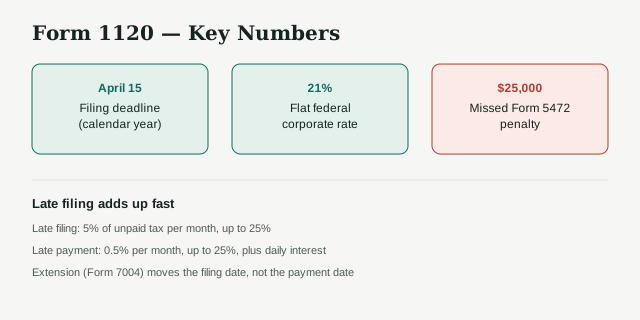
Form 1120, the U.S. Corporation Income Tax Return, is how every C corporation reports income, deductions, and credits and calculates what it owes at the flat 21% federal corporate rate. A calendar-year corporation files it by the 15th day of the fourth month after year-end, which is April 15, with a six-month extension to October 15 available on Form 7004. The extension moves your filing date, not your payment date. And if your C-corp is at least 25% foreign-owned, which describes most Indian-founded US startups, you must attach Form 5472 or risk a $25,000 penalty. A pre-revenue startup with no income still files. "We made nothing" is not an exemption.
What Is Form 1120, and Who Has to File It?
Form 1120 is the federal return for C corporations, full stop. If you incorporated in Delaware and didn't elect S-corp status, you're a C-corp, and this is your return regardless of size or stage. That covers the overwhelming majority of venture-backed startups, because the standard YC-style Delaware C-corp is built for outside investment and can't be an S-corp once foreign or institutional shareholders are on the cap table.
Other structures file elsewhere: S corporations file Form 1120-S, partnerships file Form 1065, single-member LLCs usually report on Schedule C of the owner's Form 1040, and multi-member LLCs default to Form 1065 unless they elect corporate taxation. The trade-off C-corp founders accept is double taxation: the company pays 21% on profits, and shareholders pay again on dividends. In exchange, they get the clean equity structure investors expect. In our work with early-stage teams across San Francisco and Bengaluru, nearly every funded startup we onboard is a Delaware C-corp filing Form 1120.
Bottom line: If you're a Delaware C-corp and didn't actively elect S-corp status, Form 1120 is your annual federal return. Stage and revenue don't change that.
The One Attachment Cross-Border Founders Forget: Form 5472
Here's where US-India founders get burned. If a foreign person or entity owns 25% or more of your US C-corp, the IRS treats it as a reportable corporation and requires Form 5472 attached to your Form 1120. An Indian founder who owns a quarter of a Delaware C-corp triggers it. An Indian parent company with a US subsidiary triggers it. Skip it and, per the IRS, the penalty starts at $25,000 per form, per year.
What makes this dangerous is that Form 5472 applies even to dormant or pre-revenue corporations. We regularly meet founders who confidently filed a "zero" Form 1120 for a company with no income, never realizing they also owed a 5472 on every related-party transaction, including the money they wired in to capitalize the company. By the time they reach us, the penalties have often stacked across two or three years.
Bottom line: A foreign owner at 25% or more means Form 5472 rides along with your Form 1120. The $25,000 penalty applies whether or not your company made a dollar.
When Is Form 1120 Due?
Deadlines are where late penalties begin, so map them early:
- Calendar-year corporations (December 31 year-end) file by April 15.
- Fiscal-year corporations file by the 15th day of the fourth month after the year ends. A June 30 year-end, for example, is due October 15.
- Need more time? Form 7004 grants an automatic six-month extension, pushing a calendar-year filer to October 15.
- Estimated tax payments are due on the 15th day of the 4th, 6th, 9th, and 12th months of the tax year.
The trap is treating the extension as a payment delay. It isn't. Per the IRS, Form 7004 extends only the time to file the return. Any tax owed is still due on the original date, and interest and penalties start accruing the day after. Founders who file an extension and assume they've bought breathing room on the cash are usually wrong.
Bottom line: Extension extends paperwork, not payment. Estimate and pay what you owe by the original deadline even if the return goes on extension.
What Goes on Form 1120: Income, Deductions, the 21% Rate, and the Schedules
At its core, Form 1120 walks from revenue to tax in a straight line. You report total income (gross receipts, less returns and allowances, less cost of goods sold, plus other income like interest or royalties), subtract allowable deductions (officer compensation, salaries, rent, depreciation, interest, and the rest), and arrive at taxable income. The flat 21% corporate rate, in place for tax years beginning after 2017, applies to that figure. Credits such as the R&D credit or foreign tax credit then reduce the tax itself, dollar for dollar.
The form also carries schedules that the IRS reads as a financial cross-check. Schedule L is your balance sheet at the start and end of the year. Schedule M-1 reconciles the income on your books with the income on your return, explaining why they differ. Schedule M-2 tracks changes in retained earnings. When these don't tie out, the IRS notices, and inconsistent schedules are one of the faster ways to invite questions.
One modern wrinkle hit tech startups hard between 2022 and 2024: Section 174 required research and development costs to be capitalized and amortized rather than deducted in the year spent, five years for domestic R&D and fifteen for foreign. For tax years beginning after December 31, 2024, new Section 174A restores the option to deduct domestic R&D immediately again; foreign R&D still amortizes over fifteen years. For a startup that spent heavily on engineering in an earlier year, the old rule can still turn a book loss into taxable income on an amended or catch-up basis. The R&D credit on Form 6765 can offset some of it, but only if you claim it correctly.
Bottom line: Income minus deductions, taxed at 21%, with schedules that must reconcile. Section 174 can create taxable income even when your books show a loss, so don't assume a money-losing year means a zero return.
How to File Form 1120, Step by Step
The mechanics are manageable if you work in order:
- Gather your financials: income statement, balance sheet, general ledger, payroll records (W-2s and 1099s), and last year's return.
- Complete the header: legal name, address, EIN, tax year, and return type (initial, final, or amended).
- Report income in the income section, from gross receipts down through other income.
- Enter deductions, including officer compensation on Line 12, salaries, rent, depreciation, and the rest.
- Compute the tax: taxable income times 21%, less credits, plus any other taxes, then subtract estimated payments already made.
- Complete Schedules L, M-1, and M-2, and attach Form 5472 if you're foreign-owned.
- Review for consistency across schedules, e-file (the IRS requires it for many corporations, including those with $10 million or more in total assets), and pay any balance due by the deadline.
In practice, the work that determines whether this goes smoothly happens before step one: clean monthly bookkeeping. A return built on a reconciled ledger takes days. A return built on a shoebox takes weeks and usually produces the schedule mismatches that draw scrutiny.
What It Costs to File Late or Wrong
The IRS prices non-compliance in layers, and they add up fast:
- Late filing penalty: 5% of the unpaid tax for each month or part of a month the return is late, up to 25%.
- Late payment penalty: 0.5% of the unpaid tax per month, also up to 25%, and it applies even if you filed an extension.
- Interest: the federal short-term rate plus 3%, compounded daily, with no maximum.
- Audit exposure: late or inconsistent filings raise your odds of review, sometimes across multiple prior years.
Stack a missed Form 1120 on top of a missed Form 5472 and a foreign-owned startup can owe penalties that dwarf any actual tax. We see this pattern with founders who came to the US, incorporated quickly, and assumed compliance could wait until revenue arrived.
Bottom line: Filing late costs 5% a month, paying late costs another 0.5% a month, and interest compounds daily on top. For foreign-owned C-corps, the 5472 penalty is the one that does the real damage.
The Mistakes We See Founders Make
A few errors come up again and again. Founders assume a pre-revenue company owes nothing and skip the return entirely, when both Form 1120 and, if applicable, Form 5472 are still required. They confuse federal and state obligations, treating their Delaware franchise tax (due March 1, separate from the IRS) as if it covered their federal return. They miss deductions they were entitled to, or claim credits they can't substantiate. And they ignore quarterly estimated payments, then face an underpayment penalty even in a year they break even.
The cross-border versions are the costliest. An Indian parent capitalizing a US subsidiary creates reportable related-party transactions on Form 5472. A US C-corp with an Indian subsidiary can trigger Form 5471. Layer in Section 174 and FBAR obligations, and the annual filing is no longer a single form. It's a stack, and the penalties for getting it wrong are individually large.
Bottom line: The expensive mistakes aren't arithmetic. They're skipped forms, conflated federal and state deadlines, and cross-border attachments founders never knew applied to them.
FAQs
Does my startup have to file Form 1120 if it made no money?
Yes. A C corporation files Form 1120 every year it exists, regardless of revenue. A pre-revenue or dormant Delaware C-corp still files, and if it's 25% or more foreign-owned, it also attaches Form 5472. "We earned nothing" is not a filing exemption.
When is Form 1120 due for a calendar-year C-corp?
April 15, the 15th day of the fourth month after a December 31 year-end. Form 7004 gives an automatic six-month extension to October 15, but it extends only the filing deadline, not the payment. Any tax owed is still due April 15.
What's the corporate tax rate on Form 1120?
A flat 21% on taxable income, in effect for tax years beginning after 2017. Credits such as the R&D credit reduce the tax directly, so the effective rate can be lower.
I'm an Indian founder who owns a US C-corp. Do I file anything extra with Form 1120?
Almost certainly Form 5472. If a foreign person or entity owns 25% or more of the corporation, the IRS requires Form 5472 attached to Form 1120, and the penalty for missing it starts at $25,000. It applies even to dormant companies with related-party transactions like founder capital contributions.
Is Form 1120 the same as Delaware franchise tax?
No. Form 1120 is your federal income tax return to the IRS. Delaware franchise tax is a separate state obligation, due March 1 for corporations, owed simply for being incorporated in Delaware. Many founders pay one and forget the other.
What's the penalty for filing Form 1120 late?
5% of the unpaid tax per month, up to 25%, for filing late. If you also pay late, add 0.5% per month, plus interest at the federal short-term rate plus 3% compounded daily. A return with no tax due generally avoids the failure-to-file penalty, but a foreign-owned company still faces the separate 5472 penalty.
Can I file Form 1120 myself?
You can, and the IRS supports e-filing. But once you add Schedules L, M-1, and M-2, Section 174 capitalization, R&D credits, or cross-border attachments like Form 5472 or 5471, most founders are better served by a professional. The cost of one missed cross-border form usually exceeds a year of help.