Controller vs CFO: Who to Hire First
As your startup grows, financial complexity increases. At some point, you'll need senior financial leadership, but which role should you prioritize: a Controller or a Chief Financial Officer (CFO)? Both play critical but distinct functions in your startup’s financial journey. Here's how you can decide which one to hire first.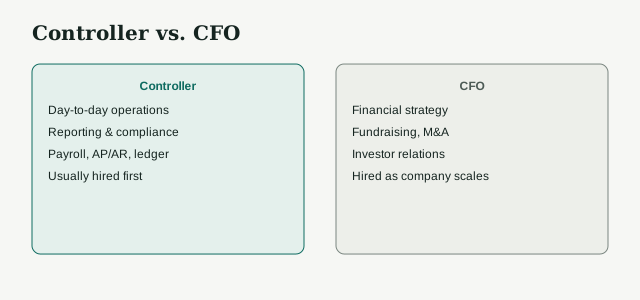
Controller vs CFO: What’s the Difference?
Controller: Manages Your Startup’s Financial Operations
A Controller is typically the first senior finance hire in a startup, and the role leans on the same recordkeeping standards the IRS expects. Their focus is on the company’s day-to-day financial operations, ensuring accurate financial reporting, compliance, and internal controls. Think of the Controller as the person who keeps your financial house in order.Key responsibilities of a Controller include:
- Prepare monthly, quarterly, and annual financial statements according to accounting standards
- Oversee accounts payable, accounts receivable, payroll, and general ledger accuracy, including quarterly Form 941 payroll filings and watching the $50,000 lookback threshold that shifts deposits from monthly to semi-weekly
- Implement internal control systems to prevent fraud, errors, and inefficiencies
- Ensure tax compliance and adherence to financial regulations, helping the company avoid the 20% accuracy-related penalty under Section 6662 for a substantial understatement of tax
- Support external audits and provide audit-ready documentation
Chief Financial Officer: Develops Your Startup’s Financial Strategy
While the Controller focuses on maintaining financial integrity, the CFO takes a broader strategic approach to financial management, including whether to elect immediate expensing or voluntary capitalization for R&D costs under Section 174A. As the top financial executive, the CFO is responsible for shaping the company’s financial strategy and driving sustainable growth.Key responsibilities of a CFO include:
- Develop long-term financial strategies aligned with the company’s goals by collaborating with executive leadership
- Evaluate market opportunities and potential risks to recommend initiatives that improve profitability
- Oversee capital fundraising efforts, including equity and debt financing, while assessing optimal capital structure
- Manage liquidity, currency exposure, interest rate risks, and financial stability in volatile market conditions
- Maintain investor relationships by providing transparent financial reporting and strategic updates
When to Hire a Controller
You should consider hiring a Controller when:- Your monthly transaction volume is increasing and becoming difficult to manage.
- You need timely and accurate financial reports to support operational decisions.
- You’re preparing for audits or raising capital and need better financial discipline.
- You’ve outgrown bookkeeping software and need someone to manage systems and workflows.
Advantages
- Can manage multiple accounting tasks early on, even without a full team.
- Helps establish accurate financial reporting and strong compliance practices.
- Builds a reliable financial foundation before shifting to a long-term strategy.
- Typically, it is more affordable than hiring a CFO.
Disadvantages
- Focuses more on accounting than strategic growth.
- May lack experience in fundraising and investor communication.
- Delaying a CFO hire could slow your strategic planning and business growth.
When to Hire a CFO
You should consider hiring a CFO when:- You’re raising capital and need a finance leader to work with investors.
- You need financial modeling and forecasting to support strategic decisions.
- You’re considering mergers, acquisitions, or international expansion.
- You want a forward-looking financial strategy to guide long-term growth.
Advantages
- Brings experience in securing funding and managing investor relationships.
- Helps the CEO with financial direction and business scaling.
- Send a strong message to investors about the maturity of your financial operations.
Disadvantages
- Higher salary costs that may not fit early-stage budgets.
- May need a supporting team, which increases costs further.
- Finding a startup-ready CFO can be difficult, which is why many startups bridge the gap with a fractional CFO at a fraction of a full-time $200,000+ salary.
Can a CFO Do the Work of a Controller?
Yes, if the CFO has a strong accounting background. In early-stage startups, it’s not uncommon for a CFO to manage both strategic finance and day-to-day accounting. However, this becomes inefficient as the company scales. A CFO’s time is better spent on strategy, not managing payroll or reconciling accounts. For budget-conscious startups, consider:- Hiring a fractional CFO for part-time strategic support.
- Outsourcing a Controller or using accounting services to handle the books.
Controller vs CFO: Who Should You Hire First?
Simple rule:- If your biggest challenge is bookkeeping, reporting, or compliance, hire a Controller.
- If your biggest challenge is fundraising, cash flow, or financial strategy, hire a CFO.
Need Help Managing Startup Finances?
Contact us for a free consultation.
At LedgersCFO, we support startups at every stage of their journey. Whether you’re laying the foundation with your first accounting system or making important decisions about funding and growth, our team works closely with you to build a strong financial base and a clear path forward. We’re here to help you take control of your startup’s future with confidence and clarity.FAQs
What is the primary difference between a Controller and a CFO?
A Controller manages financial reporting and compliance, while a CFO handles financial strategy, fundraising, and long-term planning.
Can a startup hire both a Controller and a CFO at the same time?
Yes, if the company has sufficient budget and complexity. Often, startups hire a Controller first, then bring on a CFO as they scale.
How much does it cost to hire a Controller or CFO?
Full-time Controllers typically cost less than CFOs. Startups often use fractional or outsourced options to manage costs.
Do I need a CFO if I already have a tax accountant?
A tax accountant focuses on filing returns. A CFO builds your financial strategy, manages investor relations, and helps you grow.
How can LedgersCFO help me decide whether I need a Controller or a CFO?
LedgersCFO offers advisory services, grounded in the SBA's guide to managing business finances, to help startups assess their financial needs. We guide you on when to hire, who to hire, and even provide outsourced CFO and Controller services tailored to your growth stage.